Orbit Books

The Tyrant's Law by Daniel Abraham

The Tyrant’s LawDaniel Abraham

The third instalment in this enthralling epic fantasy series, from the author of the critically acclaimed Long Price Quartet.
Read a sample


Promise of BloodBrian McClellan

An explosive fantasy debut from a rising star in the genre.
Read a sample

Posts Tagged ‘Post-apocalyptic’

author post

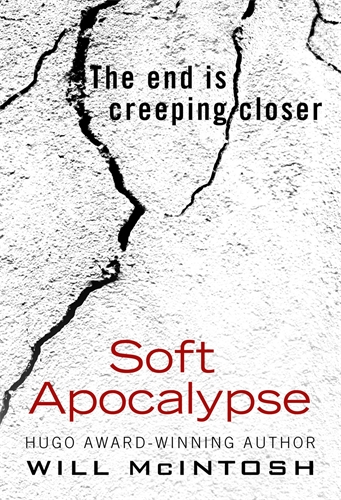
Will McIntsosh is the Hugo Award-winning science fiction author of SOFT APOCALYPSE and HITCHERS (both released as digital editions this Thursday in UK and ANZ), as well as the up-and-coming LOVE MINUS EIGHTY (released worldwide in June 2013). Will tells us below about exactly what kind of apocalypse he envisages . . .

Soft Apoclaypse, an apocalyptic science fiction novel from Hugo award-winning author whose other novels include HITCHERS and the up-and-coming LOVE MINUS EIGHTY

I’ve had a longstanding interest in the end of the world. I’m not a True Believer – I don’t have a six month supply of freeze-dried food and a ten year supply of ammo stored in a bunker under my house – but I do believe the likelihood of an apocalypse is greater than most people think.

In most apocalyptic literature, the apocalypses are caused by sudden, surprising, cataclysmic events, like nuclear weapons, meteors, or killer viruses. I wrote a novel about a “soft apocalypse”, where things unravel slowly, over the course of decades. Rather than one event, a series of events cause a long, slow decline, and the world population dies off gradually. If there is an apocalypse, I think this is how it will happen. Here’s why.

A social psychologist named Dan Gilbert pointed out that the human mind has evolved to react primarily to immediate threats, especially if those threats have a clearly identifiable cause, and especially if that cause is an identifiable person or group of people. In other words, we’ve evolved to react to immediate threats perpetrated by human villains. The terrorist attacks of 9/11 were exactly that kind of threat. During the cold war, the threat was nuclear annihilation, and the villains were the leaders of the Soviet Union or the United States, depending on where you lived. These sorts of threats scare the hell out of us. We sit up, pay attention, and take action if we can. Read the rest of this entry »

Civilisation: are we doomed? SKYFALL and 3 other ways of looking at it . . .

The poster for the latest Sam Mendes bond movie Skyfall, starring Daniel CraigLast weekend, along with millions of other people I’m sure, I went to see the latest Sam Mendes Bond movie, SKYFALL. I found the film highly entertaining – with some very impressive action scenes, a slickest of slick opening sequence, a surprisingly believable plot (for an action movie I mean…), and a rather irresistible performance from the easy-on-the-eye Daniel Craig.

But I also found it interesting (with my Orbit hat on) that this time, 007 wasn’t having to save the world by disarming a nuclear warhead (think MOONRAKER or THUNDERBALL) or stopping the spread of a deadly virus (think ON HER MAJESTY’S SECRET SERVICE) or prevent an evil communist plot (think CASINO ROYALE and a whole host of other Bonds).

This time, Bond’s role was to combat the destruction looming from the leak of confidential information – by the world’s most sophisticated cyber-terrorist. Highly believable in this age of Wikileaks and hackers being potentially extradited for infiltrating US military systems.

It seems that the disasters befalling the various James Bonds have been evolving through the years – seemingly to keep up with the ways in which our world, our technology and our political and social struggles have been constantly changing. Because it appears that as we progress as a species, the potential pitfalls waiting to bring down Western world and civilisation itself seem to be constantly evolving too – and growing dangerously more numerous by the day. Read the rest of this entry »

RSS Feeds
Orbit on the Web
Archives
Orbiteers
Blogroll

Please note that though we make every effort to ensure the suitability of links, Orbit cannot be held responsible for the content of external sites.